Overview
- Formulation
- Algorithms
- Numerical examples
Formulation
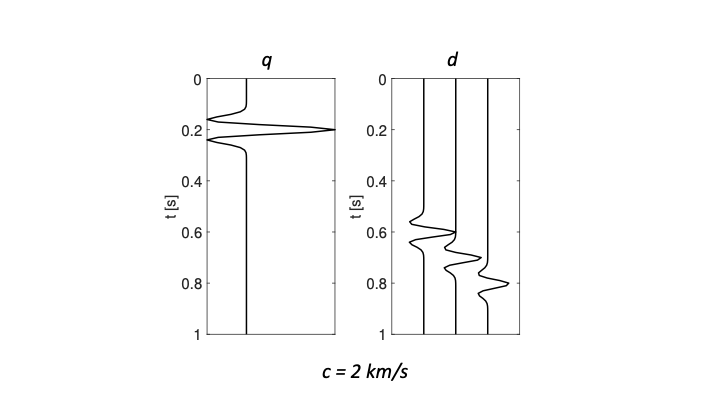
We use the following process and measurement models
$$d = Pu + \epsilon, \quad \epsilon \sim \mathcal{N}(0,\Sigma_m),$$$$A(m)u = q + \eta, \quad \eta \sim \mathcal{N}(0,\Sigma_p),$$where
- $P$ is the sampling operator
- $A(m)$ represents the PDE with coefficients $m$
- $q$ represents the source
This leads to a MAP estimation problem
$$\min_{m,u} \textstyle{\frac{1}{2}}\|Pu - d\|_{\Sigma_m}^2 + \textstyle{\frac{1}{2}}\|A(m)u - q\|_{\Sigma_p}^2.$$or equivalently,
$$\min_{m,f} \textstyle{\frac{1}{2}}\|PA(m)^{-1}(q + f) - d\|_{\Sigma_m}^2 + \textstyle{\frac{1}{2}}\|f\|_{\Sigma_p}^2.$$Various extended source arise by choosing $\Sigma_p$ appropriately1,2.
Huang, Guanghui, Rami Nammour, and William W. Symes. "Volume source-based extended waveform inversion." Geophysics 83.5 (2018): R369-R387.↩
Symes, William W., Huiyi Chen, and Susan E. Minkoff. "Full-waveform inversion by source extension: Why it works." SEG Technical Program Expanded Abstracts 2020. Society of Exploration Geophysicists, 2020. 765-769.↩
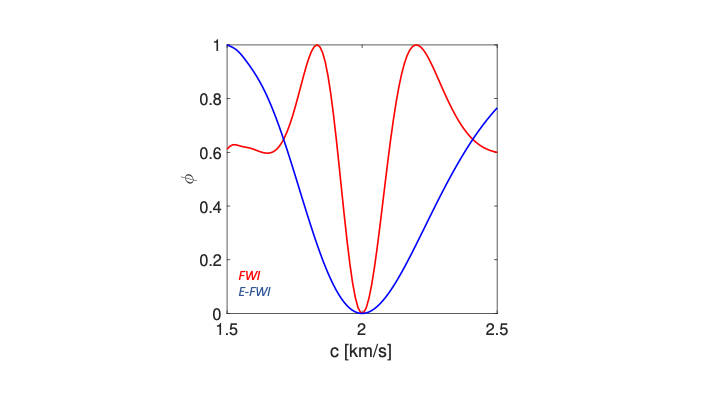
Advantages of these formulations include
- Take in to account errors in the physics
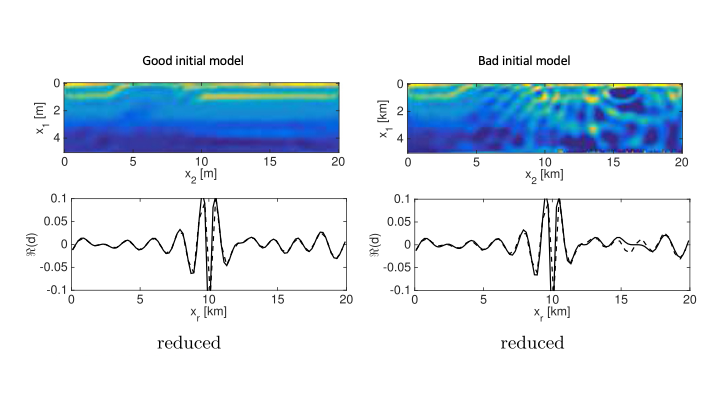
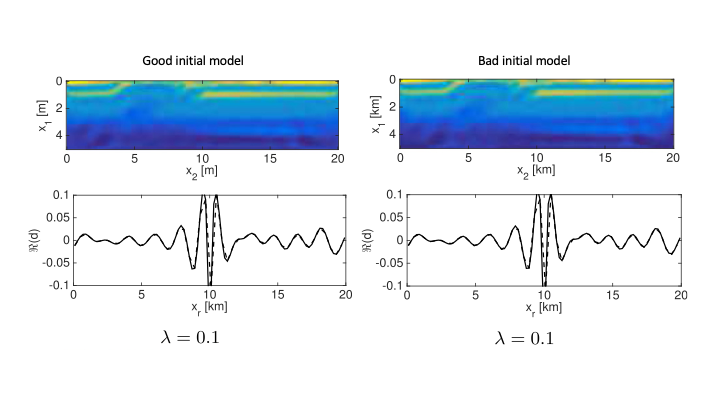
- Make inversion more robust to initialisation
Extended FWI
A reduced formulation
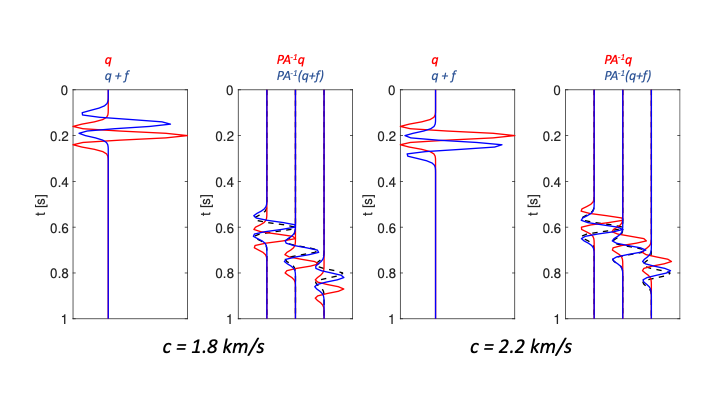
The gradient of the corresponding objective can be computed via
$$g = G(m,u_0)^*\left(w_0 - v_0\right),$$with
- $G(m,u) = \frac{\partial A(m)u}{\partial m},$
- $u_0 = A(m)^{-1}q,$
- $v_0 = A(m)^{-*}P^*\Sigma(m)^{-1}(Pu_0 - d),$
- $w_0 = A(m)^{-1}\Sigma_p^{-1}v_0.$
Algorithms
The main tasks of a basic gradient-descent method are
- Solving the forward PDE to compute the residual
- Solving a deconvolution problem to weigh the residual
- Solving an additional forward and adjoint PDE to compute the gradient
The deconvolution requires inverting
$$\Sigma(m) = \Sigma_m + P(A(m)^*\Sigma_p^{-1}A(m))^{-1}P^*.$$- want to avoid forming and storing the full matrix
- matvecs require additional PDE solves
We are free to choose $\Sigma_p$, however, so why not choose
$$\Sigma_p^{-1} = ss^*,$$and invert $\Sigma(m)$ using the Sherman-Morrison identity?
$$\Sigma(m)^{-1} = \Sigma_m^{-1} - \frac{\Sigma_m^{-1} zz^* \Sigma_m^{-1}}{1 + z^*\Sigma_m^{-1}z},$$with $z = PA(m)^{-1}s.$
- $s = \alpha \cdot q$ for computational convenience
- $s_i = \alpha\cdot \|x_i - x_s\|_2$ to emulate source-extension annihilator
- ...
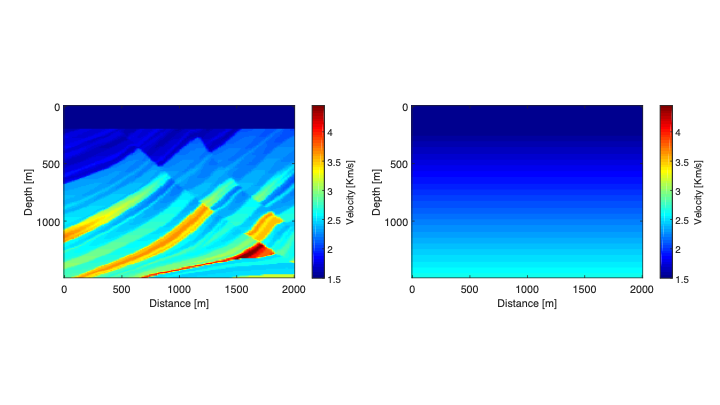
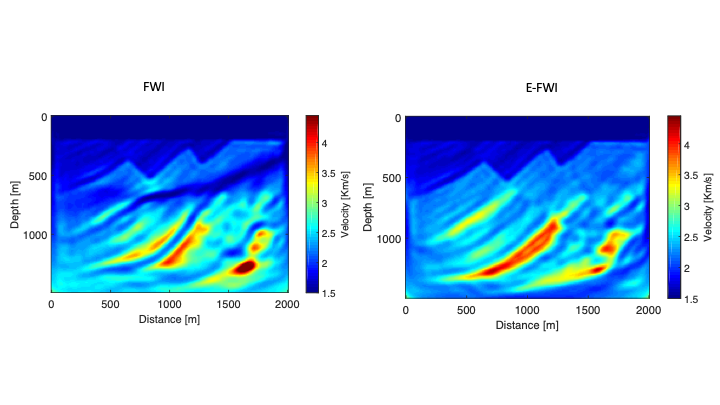
Numerical examples
Summary and outlook
Bayesian perspective on extended waveform inversion:
- Connections to various other extensions
- Efficient implementations in the time-domain
- Explore connections to data-driven approaches
Other extensions
Time-domain
Apply these methods in the time-domain remains challenging. Some approaches are based on solving
$$\left(A^*\!A + \rho^{-1}P^*\!P\right)u = A^*q + \rho^{-1}P^*d.$$- Preconditioned iterative approach1,2
- A dual formulation3
- Approximating the solution for large $\rho$4
- Neural Networks5
van Leeuwen, Tristan, Peter Jan van Leeuwen, and Sergiy Zhuk. "Data-Driven Modeling for Wave-Propagation." ENUMATH. 2019.↩
Aghamiry, Hossein S., Ali Gholami, and Stéphane Operto. "Accurate and efficient data-assimilated wavefield reconstruction in the time domain." Geophysics 85.2 (2020): A7-A12.↩
Rizzuti, Gabrio, et al. "A dual formulation for time-domain wavefield reconstruction inversion." SEG Technical Program Expanded Abstracts 2019. Society of Exploration Geophysicists, 2019. 1480-1485.↩
Li, Zhen-Chun, et al. "Time-domain wavefield reconstruction inversion." Applied Geophysics 14.4 (2017): 523-528.↩
Song, Chao, and Tariq Alkhalifah. "Wavefield reconstruction inversion via physics-informed neural networks." arXiv preprint arXiv:2104.06897 (2021).↩
Inverse scattering
- The joint approach estimates the wavefield and parameters in an alternating fashion
- Alternative approaches to estimating the full wavefield from partial data are available1,2
- Can we combine these approaches?
Diekmann, Leon, and Ivan Vasconcelos. "Imaging with the exact linearised Lippmann-Schwinger integral by means of redatumed in-volume wavefields." SEG Technical Program Expanded Abstracts 2020. Society of Exploration Geophysicists, 2020. 3598-3602.↩
Druskin, Vladimir, Shari Moskow, and Mikhail Zaslavsky. "Lippmann-Schwinger-Lanczos algorithm for inverse scattering problems." Inverse Problems (2021).↩